
In our previous post, we introduced the paradigm shift driven by NTN [read here]. Today, we’ll focus on MSSA’s mission and our Reference Architecture, the blueprint for seamless global connectivity.
The Mobile Satellite Services Association (MSSA) and its members advance and promote the value of satellite communications in the mobile satellite bands for everyone and across all applications. This includes enabling seamless global mobile connectivity by integrating terrestrial and satellite networks (non-terrestrial, or NTN) in a way that facilitates innovation, choice, and competition.
The MSSA Reference Architecture contributes to the development of a unified and accessible global communications ecosystem, enabling robust mobile connectivity and a consistent user experience regardless of location. It establishes best practices that span the entire spectrum of service delivery, which includes satellite constellations, ground infrastructure, and mobile devices, along with detailing the service delivery. MSSA ensures that the growing demands for high-speed, reliable, and secure connectivity are met effectively by addressing each component within the service chain.
Mobile Satellite Services (MSS) are represented as an integrated value chain covering the four main segments listed below:
- Space Segment: Consists of a satellite constellation that delivers coverage, capacity, and reliability by relaying communications between user devices and the ground network.
- Ground Segment: Includes gateways, Network Operations Centers (NOC), Satellite Control Centers (SCC), and cloud-based platforms connecting satellites to terrestrial networks.
- User Segment: Encompasses a range of devices, from smartphones and wearables to IoT sensors. The architecture of these devices is designed with mass-market devices in mind that typically feature constrained power and limited antenna capabilities. This reinforces the need for system-level optimization to achieve robust real-world performance.
- Service Layer: Delivers connectivity beyond the reach of terrestrial networks and supports both consumer and enterprise use cases provided either via MNO partnerships or direct-to-consumer service offering for voice, messaging, SOS, location, and data. Mission critical and monitoring communications are provided by enterprise IoT across key industries.
The diagram below depicts the satellite services delivery components.
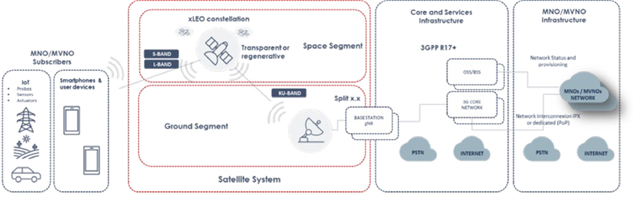
This end-to-end approach lays a foundation for the broad adoption of satellite-enabled connectivity solutions, which enhances interoperability among diverse networks and systems. Through the implementation of these practices, operators and stakeholders benefit from greater reliability and seamless integration, which are essential for expanding connectivity to any device, anytime, anywhere.
Powering 5G from Space: The 4 Pillars of 5G Satellite Networks
Delivering 5G through satellites isn’t just rocket science; it’s a balancing act. Non-Terrestrial Networks are transforming global connectivity. NTN extends mobile connectivity to places where fiber and towers can’t reach. So how do they keep your connection seamless while orbiting hundreds of kilometers above Earth?
The answer lies in delivering four critical network functions that create the backbone of NTN architecture. We’ll take a closer look at what each network function entails, highlighted in the MSS Reference Architecture.
What’s Next:
In our next article, we’ll dive into Resource Management in NTN: how satellites optimize limited resources.